Grade level and subjects
• Recommended for grades 6-12
• Subjects: Economics and Personal Finance
• Works in Classroom, Hybrid, and Homeschool settings
What students will learn
By the end of this lesson, students will be able to:
• evaluate the two sides in the debate over whether poor people are becoming poorer;
• summarize the importance of trade on our lifestyles; and
• hypothesize the effects of trade restrictions to protect citizens’ jobs.
Key concepts and terms covered
Absolute Advantage, Comparative Advantage, Cost, Opportunity Cost, and Zero-Sum Game.
Sample discussion questions
• Do we live better today than people who lived 50 years ago? Explain.
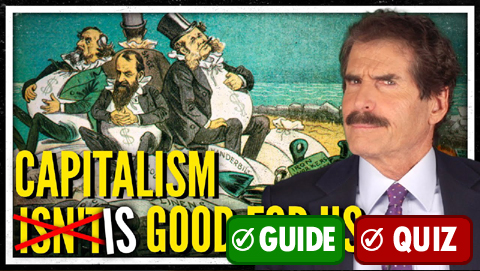
• The graph with the data from the Bureau of Labor Statistics showed income rising for all groups. How does that support or refute John Stossel’s statement about the myth of the poor getting poorer?
• In the video, there is a clip from the movie “Wall Street.” Gordon Gekko says “Money itself isn’t lost or made, it’s simply transferred.” But Abby Blanco said that new kinds of wealth are created all the time. How is wealth created?
• Why do we trade with other countries?
• According to John Stossel, the United Nations says a billion people are no longer miserably poor largely because of global trade. How does trade help people get out of poverty?
What’s in the free teacher’s guide
This printable 10-page Teacher's Guide includes a lesson description, learning objectives, key vocabulary, a fill-in viewing guide with answer key, discussion and analysis questions, and classroom activities.
Standards alignment
Aligned to state standards — use the SITC Standards Tool to match this video to the standards in your state.
 MiniGuide (includes Discussion Questions)
 Teacher’s Guide
 Google Quiz
 Printable Quiz
 Kahoot
 Video Download