 MiniGuide (includes Discussion Questions)

Want More Resources Like This?
Get new videos and resources delivered to your inbox. Always free. Unsubscribe anytime.
Want More Resources Like This?
Get new videos and resources delivered to your inbox. Always free. Unsubscribe anytime.

Home > Video Library
Overview
Why would a patriot defend the British soldiers who fired on his neighbors? How did arguments printed in newspapers shape the Constitution and the Bill of Rights? John Papola, joined by author and persuasion expert Jay Heinrichs, traces America’s history as a long public argument: John Adams’s defense of the soldiers after the Boston Massacre, the Alien and Sedition Acts, the Federalist and Anti-Federalist Papers, the Lincoln-Douglas debates, and the first televised presidential debate between John F. Kennedy and Richard Nixon.




Join our mailing list to unlock immediate access to these resources. You may unsubscribe at any time. If you’ve previously unsubscribed, your status will remain unchanged.
To help ensure our emails reach your inbox, you may provide a personal email address to bypass school spam filters.

Grade level and subjects
• Recommended for grades 6-12
• Subjects: Government, History
• Works in Classroom, Hybrid, and Homeschool settings
What students will learn
By the end of this lesson, students will be able to:
• summarize how public debates over independence, the Constitution, and the Bill of Rights shaped the founding of the United States;
• compare the arguments the Federalists and the Anti-Federalists made over ratifying the Constitution;
• examine how John Adams’s defense of the British soldiers in 1770 and his signing of the Sedition Act in 1798 show the tension between free speech and political power; and
• construct the strongest version of an opposing argument before arguing for a chosen position.
Key concepts and terms covered
Alien and Sedition Acts, Anti-Federalists, Articles of Confederation, Bill of Rights, Boston Massacre, Disinformation, Federalist Papers, Lincoln-Douglas Debates, Misinformation, Ratification, Rhetoric, Sophistry, Steelmanning, and Tenth Amendment.
Sample discussion questions
• What did the Anti-Federalists fear about the new Constitution?
• Jay Heinrichs says Adamss defense of the soldiers helped the cause of independence. How could defending the other side help your own?
• What does it mean to “steelman” an argument? How is that different from attacking a straw man?
• Adams defended an unpopular cause in 1770 and signed the Sedition Act in 1798. Why might someone who once defended open debate try to silence critics after gaining power?
• Pick one debate from the video. What was the strongest argument for the side that lost?
What’s in the free teacher’s guide
This printable 23-page Teacher’s Guide includes a lesson description, learning objectives, key vocabulary, a fill-in viewing guide with answer key, discussion and analysis questions, classroom activities, and the full video transcript.
Related resources
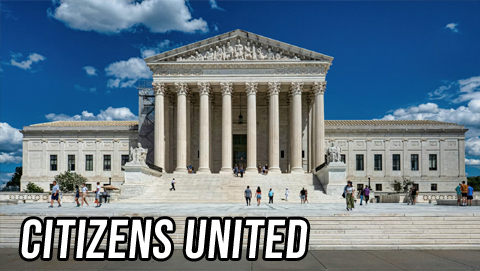
• The Power of Debate — John Stossel on the need for debate and the power of free speech.
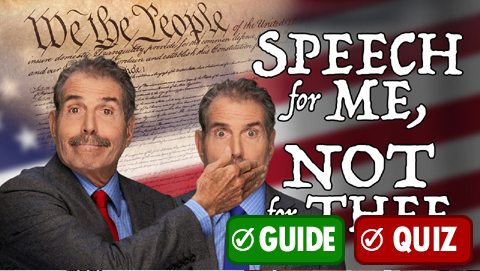
• Speech for Me, Not for Thee — What happens when leaders claim to defend free speech, but only for people who agree with them? John Stossel looks at how politicians from both major parties, once in power, have tried to silence their critics.
• America at 250 — How did America’s experiment in self-government survive for 250 years when so many others failed? John Stossel’s guests explain what made the United States different.
• Rediscovering the Constitution — Constituting America’s Janine Turner and Let Freedom Ring’s Colin Hanna on why Americans should read the Constitution.
• Both Sides: Free Speech — Should there be limits on freedom of speech? Is online speech different from offline speech? A video pairing built for classroom debate.
 Teacher’s Guide
 Google Quiz
 Printable Quiz
 Kahoot
 Video Download