Grade level and subjects
• Recommended for grades 6-12
• Subjects: Business and Government
• Works in Classroom, Hybrid, and Homeschool settings
What students will learn
By the end of this lesson, students will be able to:
• discuss the pros and cons of the U.S. Sugar Program;
• explain arguments used by the proponents and opponents of sugar subsidies;
• apply the concept of concentrated benefits and dispersed costs to government subsidies; and
• evaluate the costs and benefits of government subsidies to farmers.
Key concepts and terms covered
Subsidy, Crony capitalism, and Concentrated benefits and dispersed costs.
Sample discussion questions
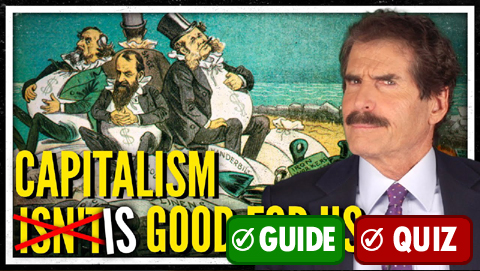
• John Stossel said that America’s biggest welfare recipients are corporations. Did you know that before watching this video? Why do you think welfare programs are normally associated with the poor when corporations are the biggest recipients?
• Because sugar corporations benefit so much from government assistance, they have a strong incentive to lobby the government to maintain these policies. But the amount that individual taxpayers must pay is relatively low, so they have a much smaller incentive to challenge the policies. What is this called? Why is this a problem?
• Some American politicians oppose ending U.S. sugar subsidies because other countries have their own subsidies, and that might put the American sugar industry at a disadvantage. Is this a good argument? Why / Why not?
• John Stossel said that sugary products “are bad for us. Maybe it’s good we eat less because they cost more.” Some politicians have argued for taxes on sugary foods for the same reason. Is raising prices a good way to get people to eat less junk food? Why / Why not?
• After watching the video and discussing it in class, are you in favor of the sugar subsidies? Why / Why not?
What’s in the free teacher’s guide
This printable 8-page Teacher's Guide includes a lesson description, learning objectives, key vocabulary, a fill-in viewing guide with answer key, discussion and analysis questions, and classroom activities.
Standards alignment
Aligned to state standards — use the SITC Standards Tool to match this video to the standards in your state.
 MiniGuide (includes Discussion Questions)
 Teacher’s Guide
 Google Quiz
 Printable Quiz
 Kahoot
 Video Download