
Quick Tip: Use SITC.org’s Voices of Liberty to launch a Women’s History Month lesson on the voices the Founders didn’t include—and why students should find them.
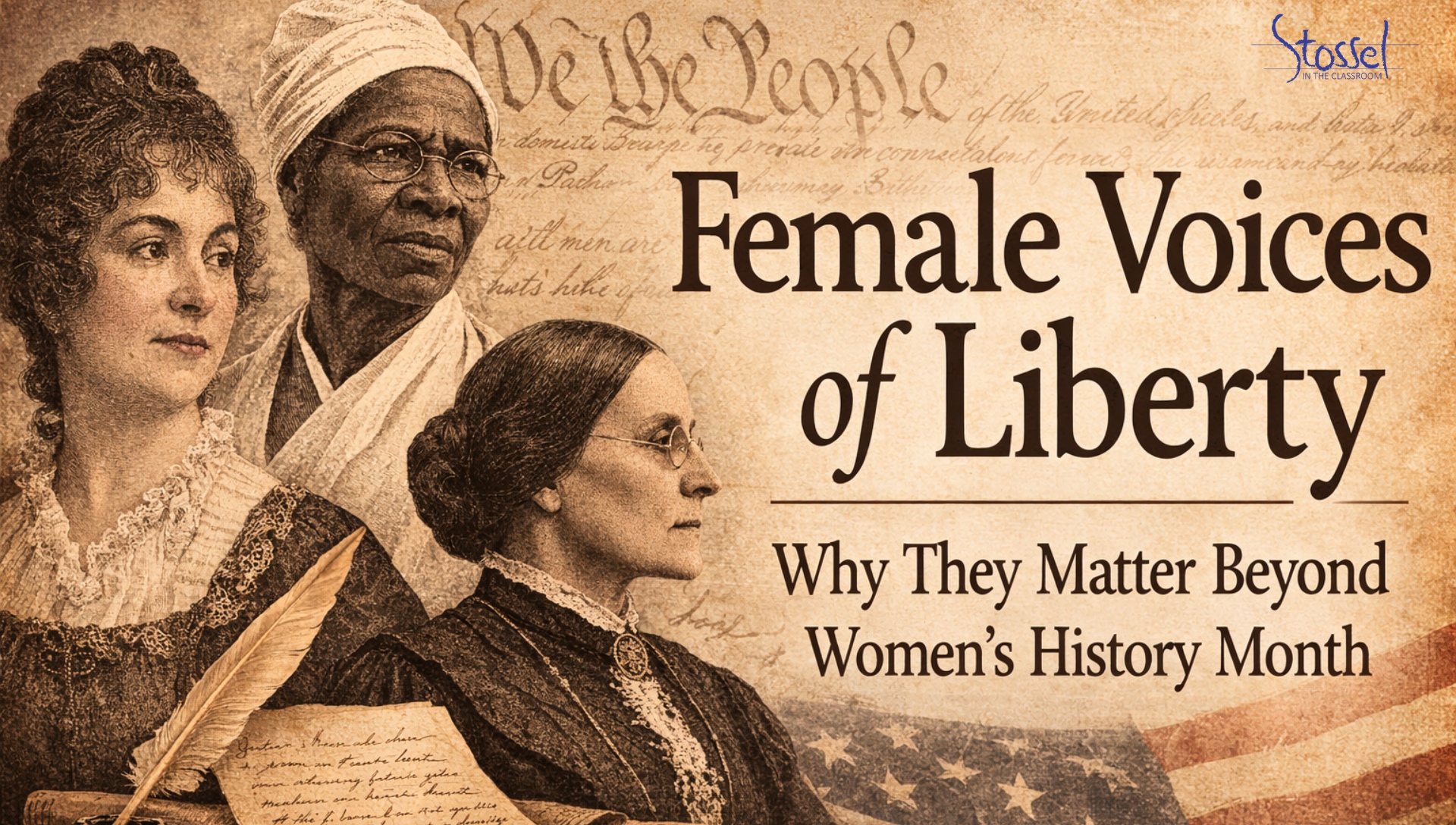
Open your copy of Voices of Liberty. Read through the table of contents.
The Declaration of Independence. Thomas Paine. The Constitution. Federalist #10. George Washington’s Farewell Address. Frederick Douglass. Martin Luther King Jr. Ronald Reagan.
Now count the women.
Zero.
That’s not a criticism of the resource. Every document and speech in Voices of Liberty earned its place. These are foundational texts in the American conversation about freedom, justice, and self-governance, and we stand behind every one of them.
Subscribe Now to Stay in the Loop
Stay updated on new videos, fresh resources, and student contest announcements.
But Women’s History Month is the perfect time to notice whose voices are present in that conversation—and whose are absent. Not because the collection is flawed, but because the history is incomplete. And that gap? It’s one of the most powerful teaching opportunities you’ll find all year.
The Same Argument, Different Voices
Here’s what makes this so teachable: the women who fought for liberty in America didn’t invent new arguments. They used the same ones. They took the Declaration’s promises and said, essentially: You wrote this. Now live up to it.
If your students have already worked with Voices of Liberty, they’ve seen Douglass do exactly this. They’ve seen King do it. The pattern is there. Women’s History Month is when you show students that women were making that same argument from the very beginning—sometimes before the ink was dry.
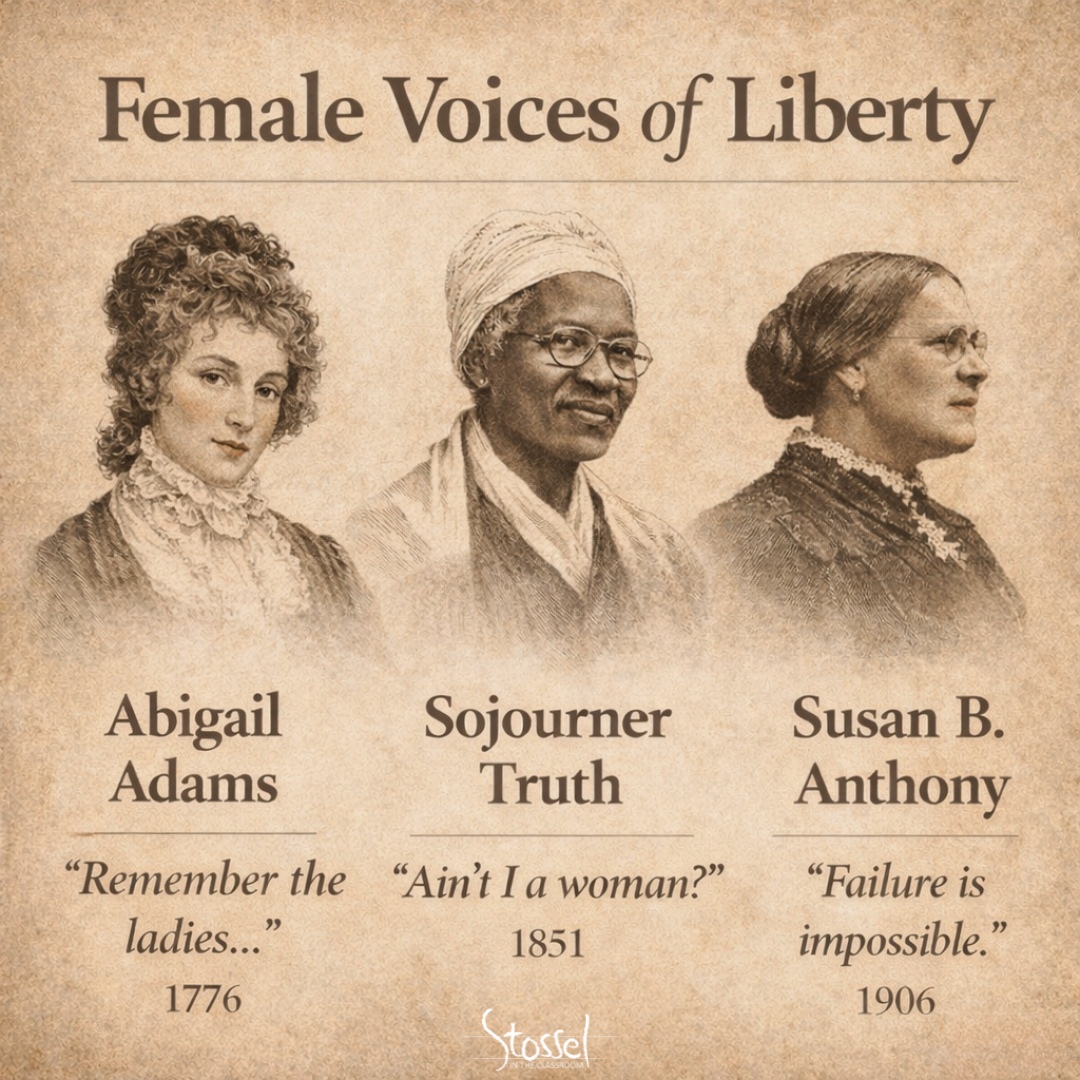
Abigail Adams (1776): “Remember the Ladies”
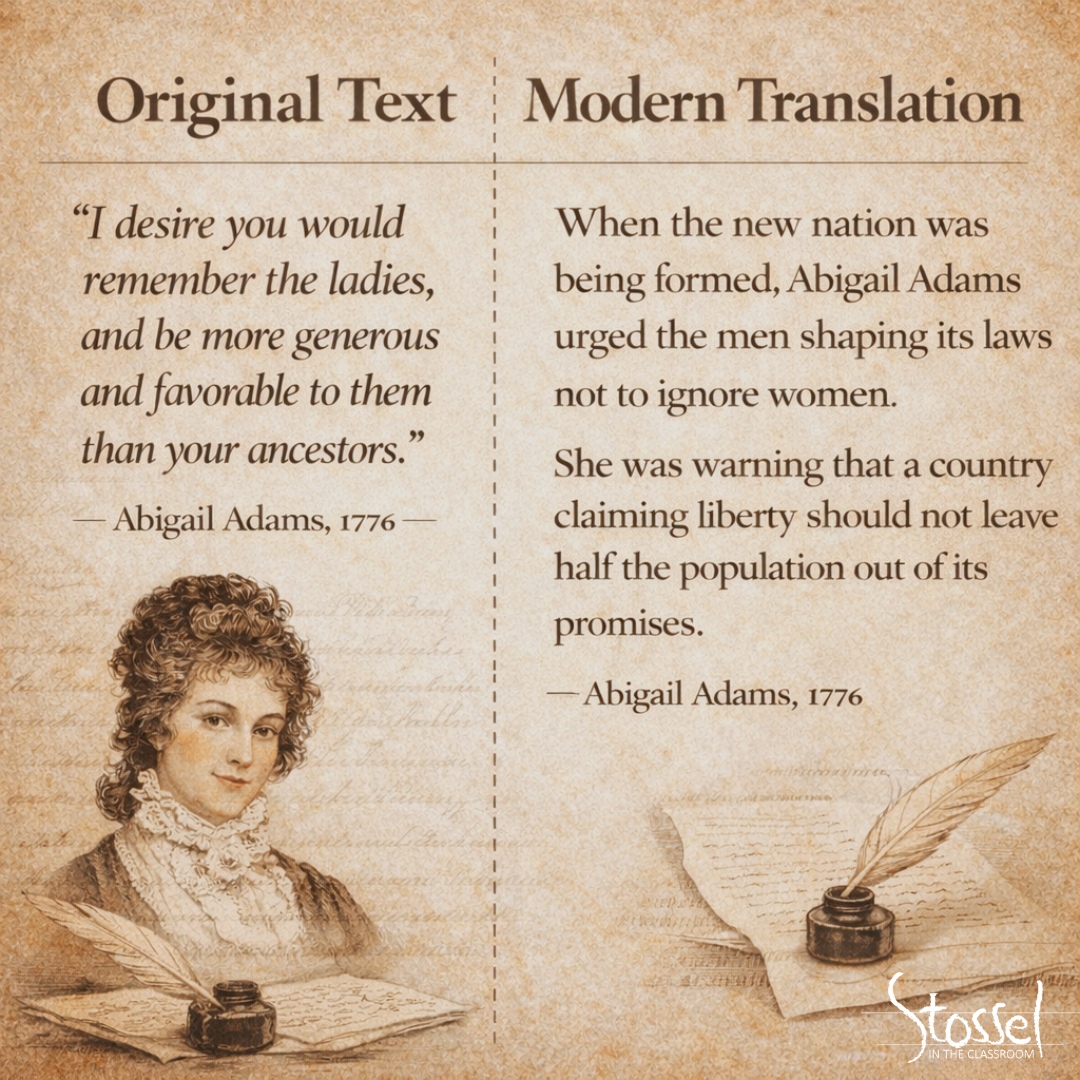
While John Adams sat in the Continental Congress, drafting the framework for a new nation, Abigail wrote him a letter that should be in every American civics class:
“I desire you would Remember the Ladies, and be more generous and favourable to them than your ancestors. Do not put such unlimited power into the hands of the Husbands.”
Notice what she does. She doesn’t beg. She warns: “If perticuliar care and attention is not paid to the Laidies we are determined to foment a Rebelion, and will not hold ourselves bound by any Laws in which we have no voice, or Representation.”
Sound familiar? That’s the same argument the colonists made against the British Crown. Abigail Adams was using her husband’s own revolution against him—in real time, in 1776.
(John’s response? He laughed. Literally. Students love that part.)
Sojourner Truth (1851): “I Am a Woman’s Rights”
Many students know Sojourner Truth from the “Ain’t I a Woman?” version of her speech. What they probably don’t know is that the famous version was written twelve years later by someone else, in a dialect Truth never spoke. (She was born in New York and grew up speaking Dutch—not Southern English.)
The earlier, more reliable version—transcribed by journalist Marius Robinson, who went over it with Truth before publishing—is shorter, sharper, and just as powerful:
“I want to say a few words about this matter. I am a woman’s rights. I have as much muscle as any man, and can do as much work as any man.”
No flowery rhetoric. No pleading. Just a woman standing up and stating her view on women’s rights. This version, by the way, is itself a great primary source lesson: students can compare the two versions and ask why the later one was rewritten, by whom, and what that tells us about how history gets shaped by people other than the ones who made it.
Susan B. Anthony (1873): “It Was We, the People”
After voting illegally in the 1872 presidential election, Susan B. Anthony stood trial and used the occasion to deliver one of the most precise constitutional arguments of the 19th century. Her strategy was elegant: she quoted the founding documents back to the government that charged her.
“It was we, the people; not we, the white male citizens; nor yet we, the male citizens; but we, the whole people, who formed the Union.”
Anthony’s argument is a direct echo of what students will find in Voices of Liberty: the founding promises apply to everyone—and when the government restricts those promises to some citizens but not others, it violates its own principles.
If students have read King’s “promissory note” passage in Voices of Liberty, Anthony’s speech will feel like the earlier draft of the same idea. The thread is the same: You wrote it. You signed it. Now honor it.
The Amendment Gap Your Students Need to See
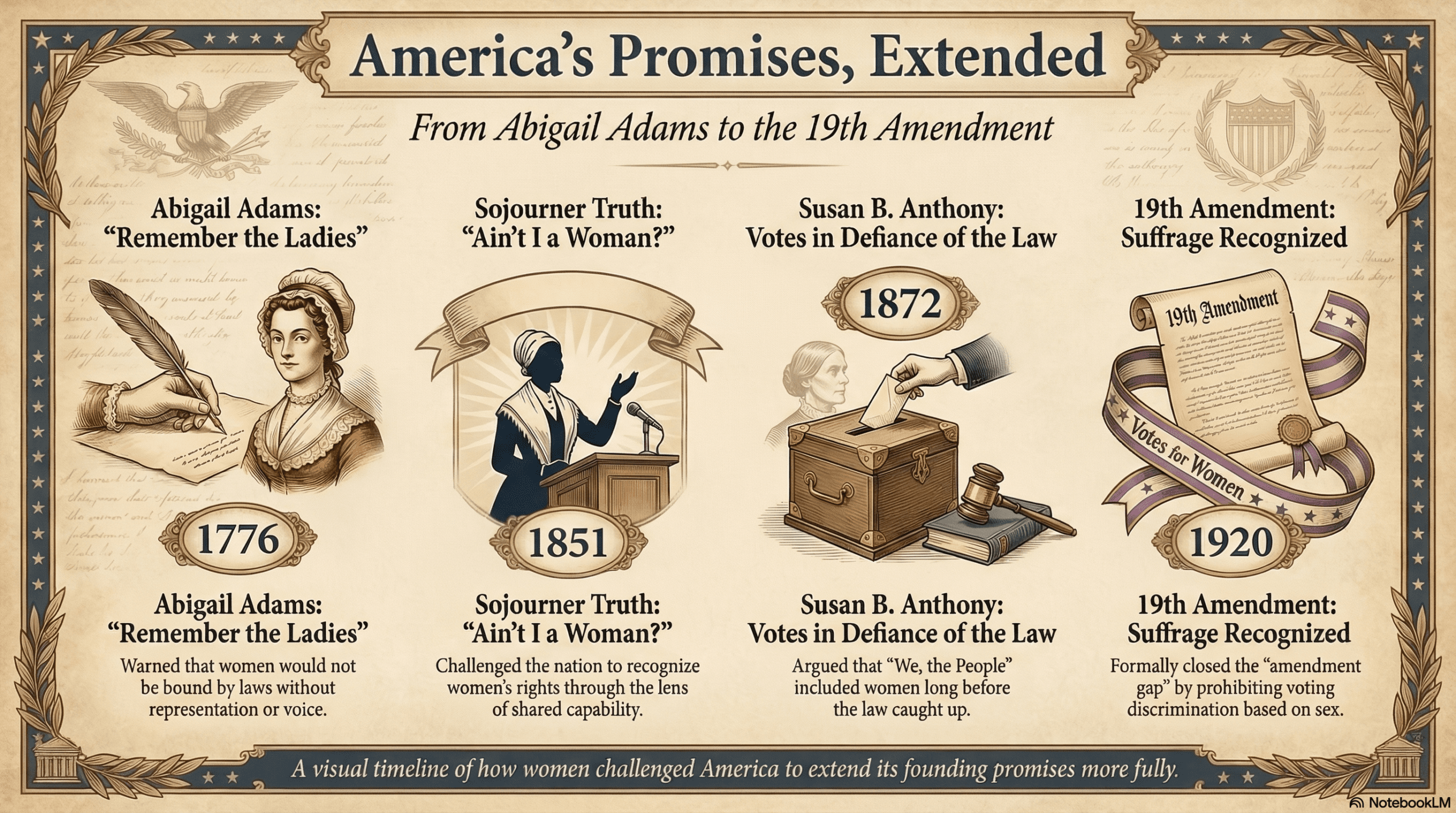
Here’s a timeline that stops students in their tracks.
The Fifteenth Amendment, ratified on February 3, 1870, declared:
“The right of citizens of the United States to vote shall not be denied or abridged by the United States or by any State on account of race, color, or previous condition of servitude.”
Race. Color. Previous condition of servitude. Not sex.
It took another fifty years before the Nineteenth Amendment, ratified on August 18, 1920, finally closed the gap:
“The right of citizens of the United States to vote shall not be denied or abridged by the United States or by any State on account of sex.”
Read those two amendments side by side with your students. The language is almost identical. The principle is the same. But between them lies half a century in which black men could constitutionally vote while women of every color could not.
That gap isn’t just a historical footnote. It’s a window into how rights expand in America—not all at once, but in hard-fought stages, each one building on the arguments that came before. Adams demanded representation in 1776. Truth claimed her rights in 1851. Anthony went to trial in 1873. And it still took until 1920.
When students see that timeline, the abstract idea of “fighting for your rights” becomes concrete…long…personal.
The Real Classroom Opportunity
Here’s where Voices of Liberty becomes a launchpad instead of just a resource.
Use the collection as your anchor. Have students read the Declaration excerpt, then Douglass, then King. By now they can see the pattern: each speaker holds America accountable to its own stated principles.
Then ask: Who else made this argument?
Introduce Adams, Truth, and Anthony. Give students the short excerpts above (or find others—there are plenty). Let them see that women were not separate from this liberty conversation. They were in it, uninvited, demanding a seat.
You can take this in several directions:
Compare the arguments. How does Abigail Adams’s 1776 letter echo the colonists’ complaints against Britain? How does Anthony’s 1873 speech echo Douglass? Students can map the rhetorical strategy across speakers and centuries.
Question the source. The Sojourner Truth comparison is tailor-made for media literacy. Two versions of the same speech, one rewritten by someone else. Which do we trust? Why? (This connects beautifully to SITC.org’s emphasis on critical thinking and checking sources.)
Notice who’s missing. Have students look at any curated collection—a textbook chapter, a list of “greatest speeches,” a museum exhibit—and ask who isn’t there. That’s not about blame or pointing fingers. It’s about developing the habit of asking: what’s the full story?
Discussion Questions for Your Classroom
- Abigail Adams, Frederick Douglass, and Susan B. Anthony all used the Declaration of Independence to argue for rights it didn’t originally protect. Why is the Declaration such an effective tool for this kind of argument?
- John Adams laughed at his wife’s request to “remember the ladies.” What does his response tell us about the gap between principles and practice in 1776?
- Two versions of Sojourner Truth’s speech exist, and the more famous one was written by someone else. What does this teach us about how history gets recorded—and by whom?
- Susan B. Anthony argued that the Constitution already guaranteed women the right to vote. Was she right? Why did it take an amendment to settle the question?
- If you were adding one woman’s voice to Voices of Liberty, whose would you choose, and why?
Why This Matters at 250
As America approaches its 250th anniversary, we’re asking big questions about who we are and who we want to be. Voices of Liberty gives students the foundational documents and speeches that shaped that conversation.
But the conversation was never limited to the voices that made it into the collection.
Women were there from the beginning—writing letters, giving speeches, getting arrested, and demanding that the nation’s promises apply to all its people. Not someday. Now.
This Women’s History Month, help your students hear those voices. Not as a separate lesson. Not as a sidebar. As the next chapter in a conversation that’s been going on since 1776.
The founding documents belong to everyone.
These women knew that. It’s time our students did, too.
Primary Source Links for Your Classroom
Share these with students or use them to build your own excerpts. All are freely available online.
Abigail Adams to John Adams, March 31, 1776 (“Remember the Ladies”)
https://www.masshist.org/digitaladams/archive/doc?id=L17760331aa
Full letter with original spellings, from the Massachusetts Historical Society’s Digital Adams Archive.
John Adams’s reply to Abigail, April 14, 1776
https://teachingamericanhistory.org/document/remember-the-ladies/
Both letters together with historical context, from Teaching American History.
Sojourner Truth, 1851 speech at the Women’s Rights Convention (Robinson transcription)
https://www.thesojournertruthproject.com/compare-the-speeches
Side-by-side comparison of the 1851 and 1863 versions, with audio in Truth’s likely accent.
Susan B. Anthony, “Is It a Crime for a U.S. Citizen to Vote?” (1873)
https://voicesofdemocracy.umd.edu/anthony-is-it-a-crime-speech-text/
Full annotated text from Voices of Democracy at the University of Maryland.
The 15th and 19th Amendments
https://constitution.congress.gov/browse/
Full text of the U.S. Constitution, via Congress.gov.