
Quick Resources: Our free Censorship module has the videos for this conversation — Speech for Me, Not for Thee, Don’t Cancel Comedy, and Both Sides: Free Speech — each with a teacher’s guide, viewing guide, and quiz at SITC.org.
Subscribe Now to Stay in the Loop
Stay updated on new videos, fresh resources, and student contest announcements.
The only time I ever took a book away from a child, I was teaching second grade.
I had been reading Tales of a Fourth Grade Nothing aloud, a chapter a day, and it had done what a good read-aloud does—sent half my class hunting for more Judy Blume. I was delighted about this, right up until I glanced over at one of my seven-year-olds and registered which Judy Blume she was holding.
Forever
I’d read it myself as a teenager. I knew precisely what was in it.
So, I very delicately relieved her of it and sent it home with a note to her mother. The note said, more or less: I’m not telling you what your daughter should read. I’m telling you that Judy Blume writes for second graders and also writes for grownups, and this one is for grownups. You may want to take a look.
Her mom thanked me.
I should say that I’m not a gatekeeper by temperament. My own parents started handing me their books around seventh grade—I hauled John Jakes’s The Bastard from class to class for two days until I finished it—and I turned out well enough to be writing this.
But I wasn’t that child’s parent. Her mother was. The entire question of who gets to choose lives in that sentence.
Banned Books Week runs October 4 through 10 this year. The theme is “Let Books Be. Protect the Freedom to Read.” Sometime in the next two weeks, a display will go up in your library, a flyer will land in your inbox, and you’ll have to decide how much of this you want to touch.
I understand the hesitation. This is a topic where a teacher can do everything right and still end up in somebody’s email to the administration. So let me offer a version of it that is defensible, rigorous, and doesn’t require you to referee anyone’s reading list.
Teach the question underneath.
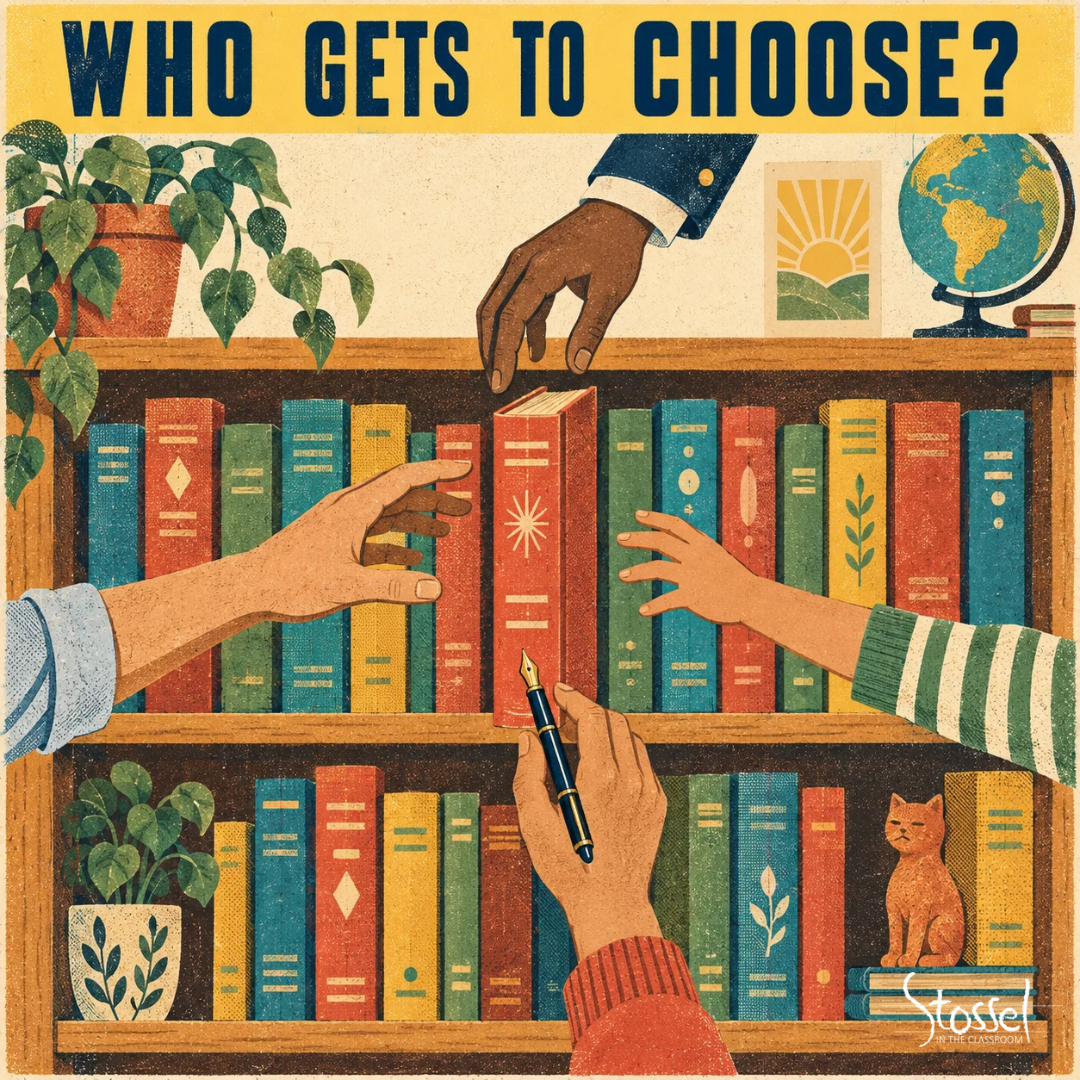
Somebody always chooses
Most coverage of this issue skips the basic concept: a school library is a curated collection. It’s always been a curated collection.
A librarian with a finite budget and finite shelf space selects a few hundred titles and passes on tens of thousands. That’s a choice. It’s made by a particular person, using particular judgment, every single year.
So, the question is never whether somebody decides. Somebody always decides. The real question—the one worth a class period—is what makes a decision process legitimate.
That question has no comfortable home. It can’t be answered by picking a team, and students figure that out fast.
Four distinctions students need first
✔ Not buying is not removing. A librarian who passes on a title has made a purchasing decision, constrained by budget and shelf space. Someone who pulls a title already on the shelf has done something else entirely. Different acts, different people, different standards—and most arguments about this collapse the two, which is where the shouting starts.
✔ A challenge is not a ban. A challenge is a request for review. A ban is a removal. A parent who objects to a book and asks the district to look at it has done a thing citizens are entitled to do. Whether the review is fair, transparent, and consistent is the actual issue.
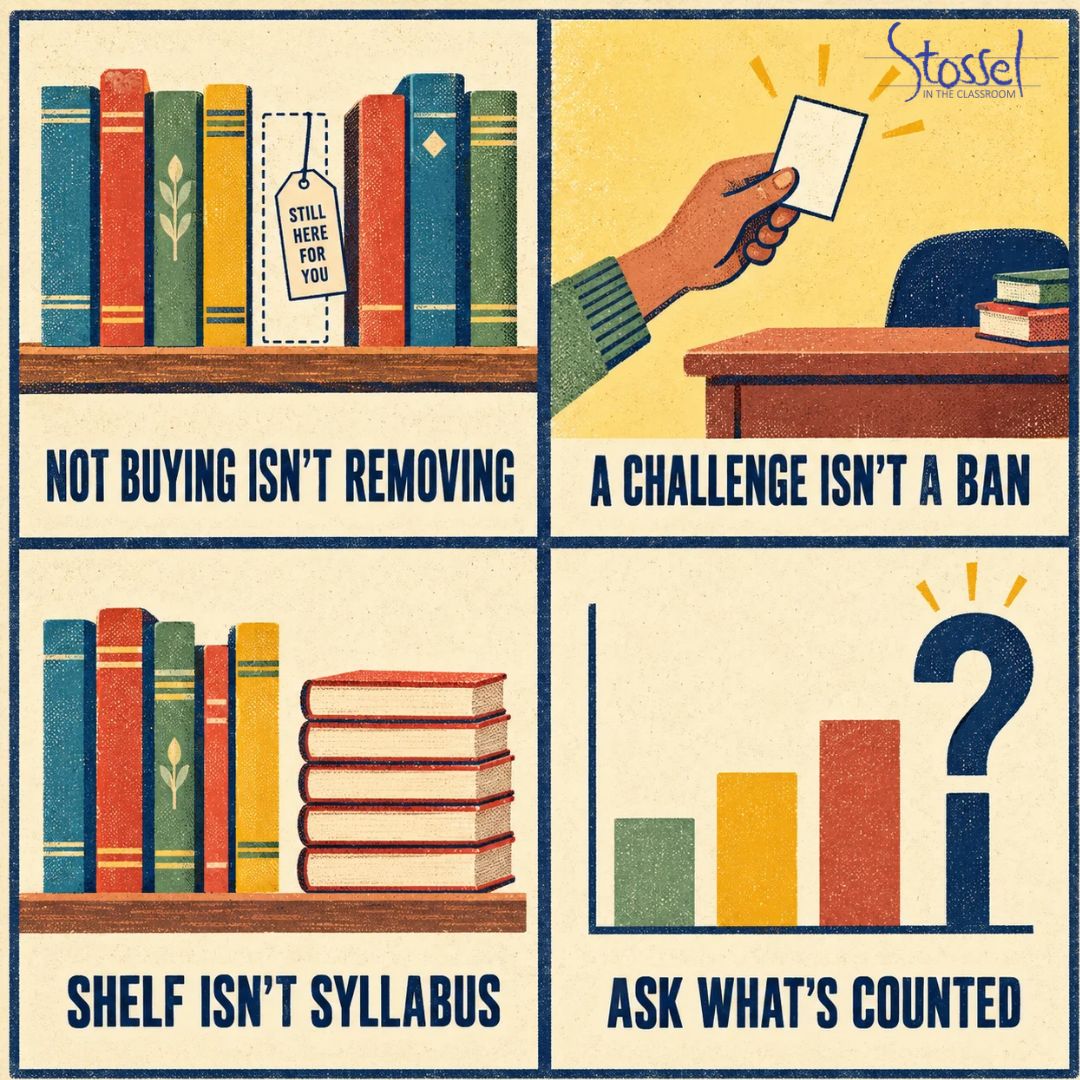
✔ The shelf is not the syllabus. A book in the library is one a student may choose. A book on the required reading list or utilized in class is one every student must read. Those are different asks, and they can reasonably answer to different standards. A parent who’s fine with the first and still wants a say in the second is not being inconsistent. This distinction defuses more arguments than any other, because a great many people who appear to disagree are answering two different questions. There’s a third category, too, and it’s the one I ran into in second grade: what a child brings from home. That one was never mine to decide.
✔ The counts are contested. You’ll see very large numbers in the news this month, and you’ll see people who dispute them. The disagreement usually comes down to what got counted—a permanent removal, a temporary review, an age restriction, a title moved from one section to another. Have students ask what a number is actually measuring before they repeat it. That habit is worth more than the number.
The test that settles it
Once students have the vocabulary, give them the tool.
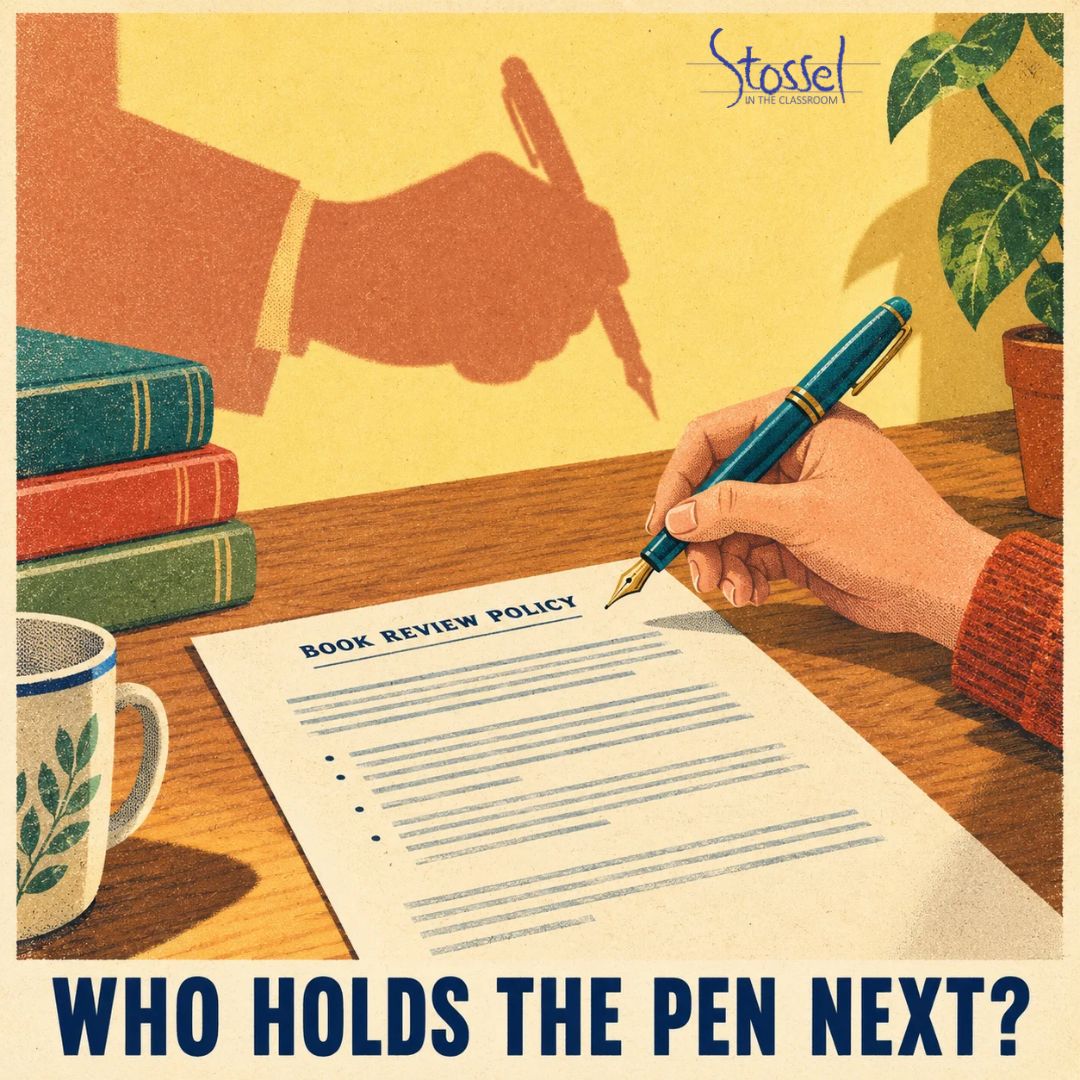
Any rule for removing books goes into the hands of someone who disagrees with you. Not hypothetically—eventually, actually. School boards turn over. Districts change. State law changes. The person applying your standard in six years is not the person applying it now.
So: write the rule you want. Then imagine your least favorite public figure holding the pen.
If the rule only feels safe when your side administers it, it’s not a rule. It’s a preference in a nice outfit.
That single move does more for a student’s civic reasoning than any amount of instruction about the First Amendment, because it forces the student to build something that has to survive losing the next election
Where the videos come in
Our Censorship module was built for exactly this conversation. Speech for Me, Not for Thee is the most direct fit—the title alone is the lesson—and “Both Sides: Free Speech” gives students two real arguments to weigh rather than one to absorb.
But my favorite way into this is sideways, through Don’t Cancel Comedy.
It asks whether comedy is facing more censorship now, whether satire is under threat, and whether humor can bridge political divides. Students arrive with opinions about comedians already loaded and ready to fire, which is precisely the advantage. Nobody is defending a book he or she hasn’t read. Everyone has a take.
And the structure of the argument turns out to be identical. Who decides what’s over the line? What happens when that authority moves? Is the answer different when the person being silenced is someone you find funny?
Get students reasoning about jokes, then hand them the harder version. The transfer is almost automatic. The guide is a printable eight pages, recommended for grades six through twelve, with a viewing guide, discussion questions, and activities already built.
Try this the week before
Put students on a committee. Their job is to write the policy their district will use when a parent objects to a book.
Give them the real constraints. Someone has to review it. There has to be a timeline. There has to be a way to appeal. Somebody has to decide what happens to the book while the review is pending.
Then, once the policies are written, reveal the second half of the assignment: the committee that will apply your policy is the group across the room, and they do not have to share your values.
Twenty minutes, and the revisions students make in the last five are the whole lesson.
Two books, one author
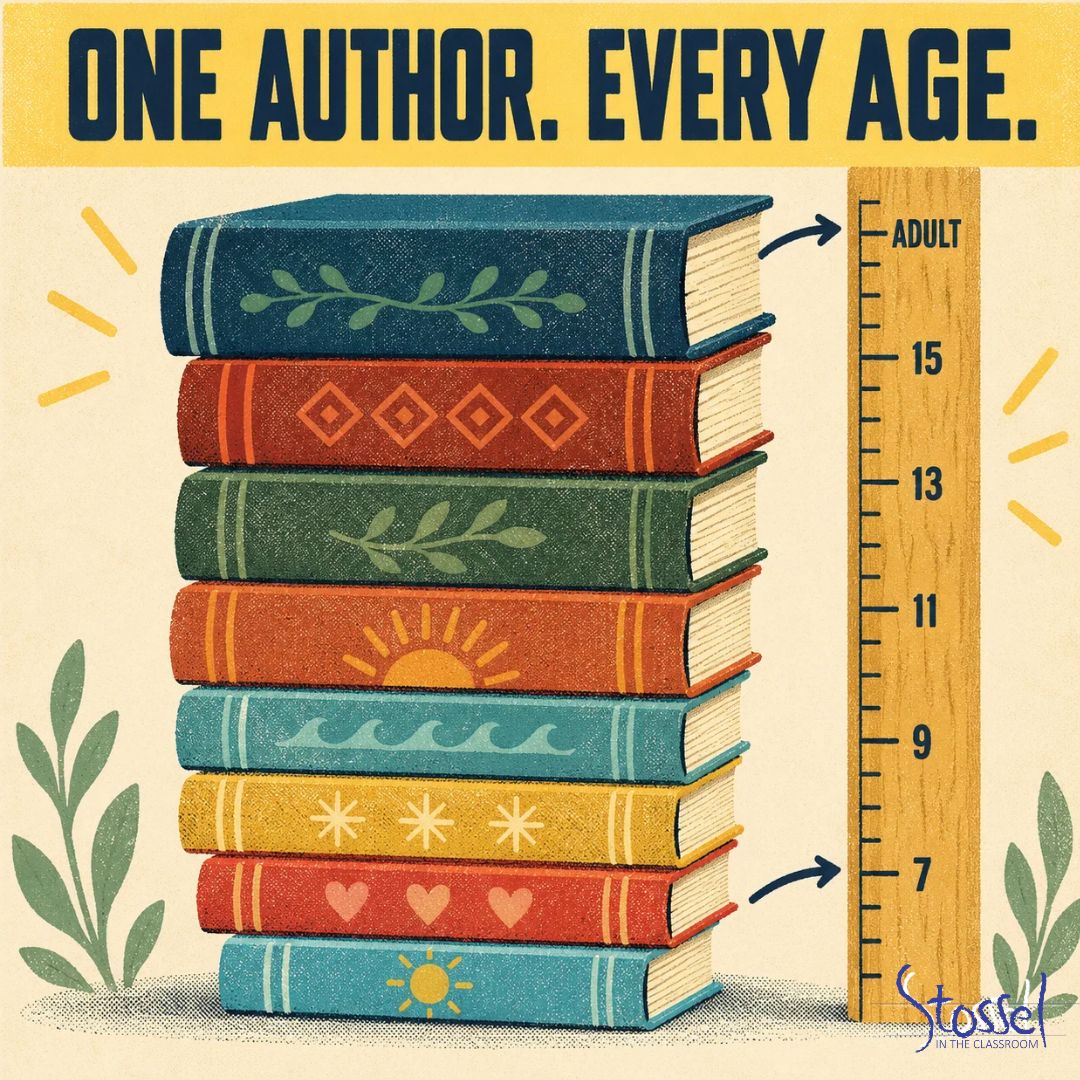
I named two book titles in this post, and both of them are by Judy Blume.
That’s not an accident. Her catalog runs from second grade to adult, which makes her the cleanest illustration I know of the thing students most need to understand. The question is almost never whether a book is good or evil. It’s who the book is for, who decides that, and whether the deciding was done in a way anyone can defend.
Everything else here I kept abstract on purpose, and it’s worth being explicit with students about why. The moment a conversation attaches to a specific contested title, everyone stops reasoning and starts defending. The principle vanishes behind the example.
Teach the principle first. Students who understand what makes a process fair can apply it to any title that comes along, including the ones nobody has thought to argue about…yet.
That’s the durable version. Not a list of approved opinions. A test a student can run himself or herself, on a question we’ve not asked yet, long after he or she has forgotten which teacher taught it.