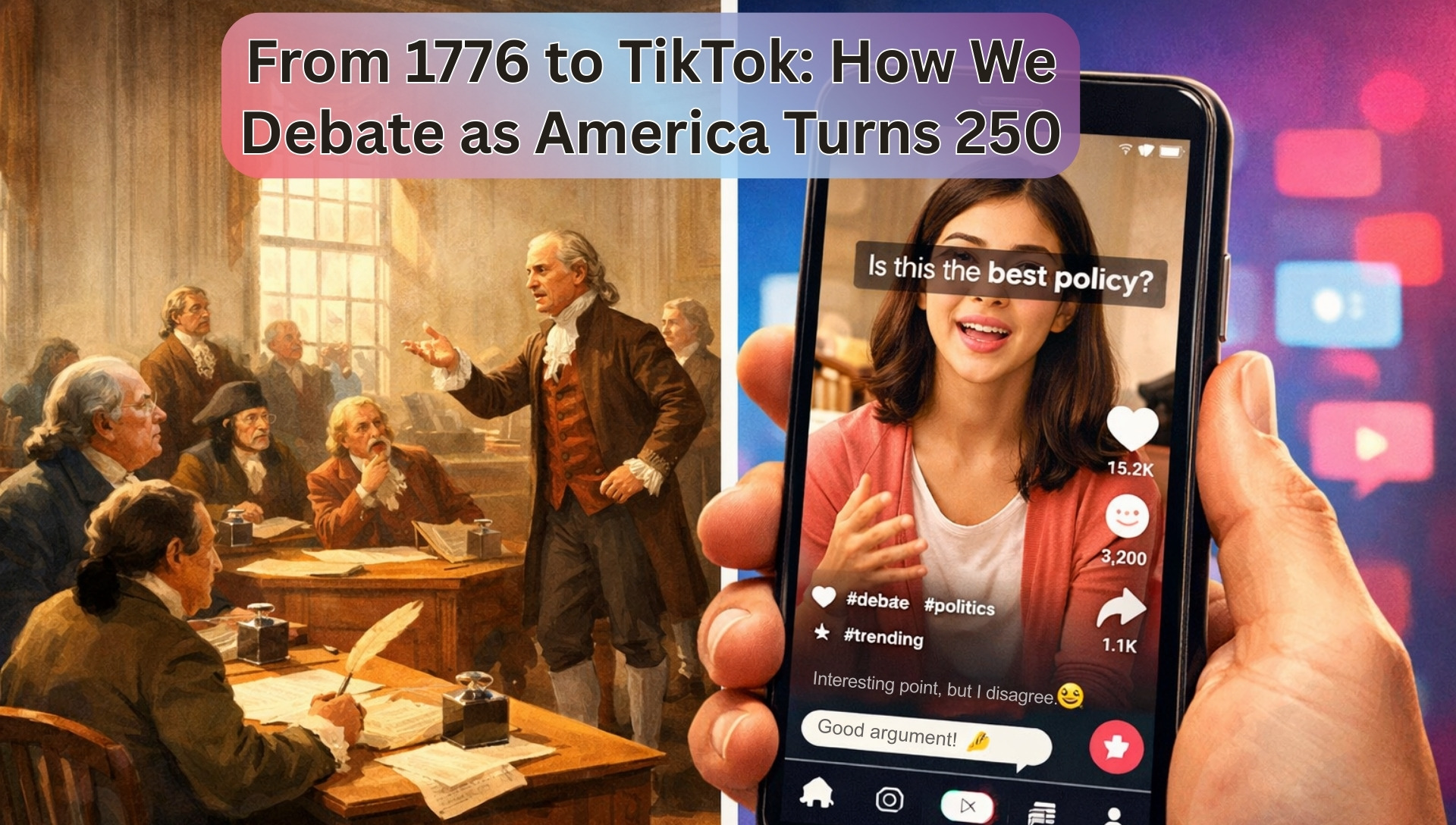
What we did not inherit was this modern fear that disagreement means you must unfriend, unfollow, or assume the worst about someone.
Somewhere along the way, we lost the ability to say:
“I think you’re wrong — but I’m listening.”
And if the Founders could see our comment sections? They’d probably ask, “What happened to the part where we talk to each other?”
America at 250: A Perfect Time to Reclaim Civil Conversation
Students today are growing up in a world where people often treat disagreement like a threat. But the Founders? They treated disagreement like a tool — a way to refine ideas, check power, and build something stronger together.
The Declaration of Independence?
A very pointed disagreement.
The Constitution?
A negotiated, line-by-line disagreement.
Federalist #10?
James Madison saying, essentially:
“Look, factions are inevitable. So let’s figure out how to manage them.”
Fast-forward 250 years, and many of the same questions still echo in classrooms:
- What do we do when we disagree?
- How do we talk about hard issues without blowing up friendships?
- How do diverse people make decisions together?
We can’t expect students to navigate a polarized world without tools.
We have to teach them how to talk — and listen — across differences.
That’s where two powerful resources come in:
Undivide Us and Voices of Liberty, connected by a classroom technique that changes everything.
Modeling Better Conversations: Why Undivide Us Resonates
One of the most important videos we share is Undivide Us, created by another organization but deeply aligned with SITC’s mission. It highlights something simple and radical:
Assume the person who disagrees with you is reasonable, not evil or ignorant.
“Too often we become entrenched in our own views, in our own echo chambers…We see each other as enemies rather than fellow citizens.” — Ben Klutsey
That idea alone can transform a discussion.
In a 250th anniversary year — when we’re reflecting not just on where we’ve been, but who we want to be — modeling respectful conversation is essential.
 MiniGuide (includes Discussion Questions)
 Teacher’s Guide
 Google Quiz
 Printable Quiz
 Kahoot
 Video Download